2025 Gauge of Rage
An Analysis of Femicide1) committed by Male Intimate Partners
and by Men Unknown to the Victim, Based on Media Reports2)
In 2025, at least 137 women were killed in the context of intimate relationships,
389 victims including attempted murder and related cases,
and 673 victims including additional victims.
In cases of women killed by men previously unknown to them,
there were 94 victims including additional victims.
These figures represent only the minimum known number of femicides.
Since 2009, Korea Women’s Hot-Line has annually published a report titled the “Gauge of Rage”, an analysis of women killed by male intimate partners based on media reports. This was intended both to remember the victims and to expose the gravity of violence against women, while also urging the government to establish official statistics that can serve as a policy foundation for addressing the problem. However, this report reflects only the minimum number of incidents known to have occurred, as this report analyzes only cases reported in the media. Moreover, because the scope of analysis is limited to intimate relationships and relationships with men previously unknown to the victim, it does not include femicides occurring in other relational contexts such as workplaces, schools, or neighborhoods, etc. The figures in this report therefore do not reflect the full reality of femicide in South Korean society. The absence of such official statistics, and the need to establish them, has also been repeatedly raised in recommendations to the Korean government by the international community.3)
In December 2025, the Ministry of Gender Equality and Family(MOGEF) announced, with the release of the 「2025 Statistics on Violence Against Women」, that it had for the first time compiled statistics capable of identifying the status of homicide, manslaughter, and violence in intimate relationships. While the launch of official statistics attempting to quantify femicide is welcome, these statistics remain insufficient to comprehensively reveal the realities of femicide in intimate relationships. For example, they do not adequately capture cases in the full context of intimate partner violence, such as deaths caused by violence that are not legally classified as manslaughter, or cases in which the perpetrator dies by suicide after the killing and the case is closed for lack of prosecutorial authority.
Thus, even now, in the 17th year since the Gauge of Rage began reporting these figures, comprehensive official statistics that present the scale and patterns of femicide in intimate relationships in a multidimensional way remain absent. In its 2025 Gauge of Rage report, Korea Women’s Hot-Line therefore analyzed femicide in intimate relationships and femicide by men previously unknown to the victim as indicators that expose this reality.
Ⅰ. Analysis of Femicide by Male Intimate Partners Based on Media Reports
In 2025, at least 137 women were killed in intimate relationships,
389 victims including attempted murders and related cases
According to Korea Women’s Hot-Line’s analysis of incidents reported in the media between January 1 and December 31, 2025, at least 137 women were killed by a male intimate partner such as a husband or boyfriend, and at least 252 women survived an attempted murder or related lethal violence by such a partner. When additional victims such as the victim’s children, parents, and friends are included, the total number of victims killed or placed at risk of being killed by a male intimate partner reached at least 673. This means that, at a minimum, one woman every 22.5 hours was killed or placed at risk of being killed by a husband, boyfriend, or other male intimate partner. Including additional victims, one person every 13.02 hours was victimized. However, because these figures represent only the minimum number of cases reported in the media, the actual number of women killed or placed at risk of being killed by male intimate partners is likely to be far higher.
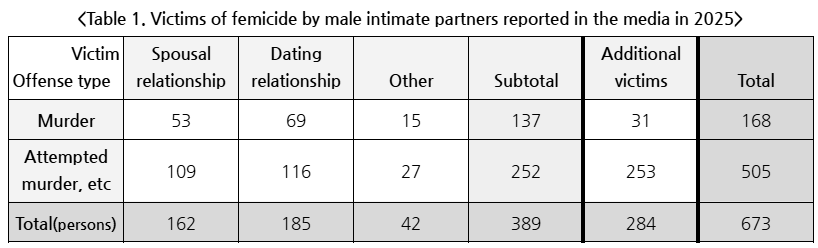
*Spousal relationship: includes past or current spouses, including those in common-law marriage
*Dating relationship: includes past or current dating relationship, including cohabitation, relationships formed by blind dates, dating applications, forum chats, transactional arrangement, etc.
*Other: relationships outside of dating and marriage, including cases where the perpetrator unilaterally seeks a romantic or sexual relationship
*Additional victims: includes the victim’s children, etc. Pet victimization is also included in this category; although the unit is standardized as “persons,” incidents are occasionally referred to as “cases” where context requires.
Femicide by male intimate partners occurred across all age groups
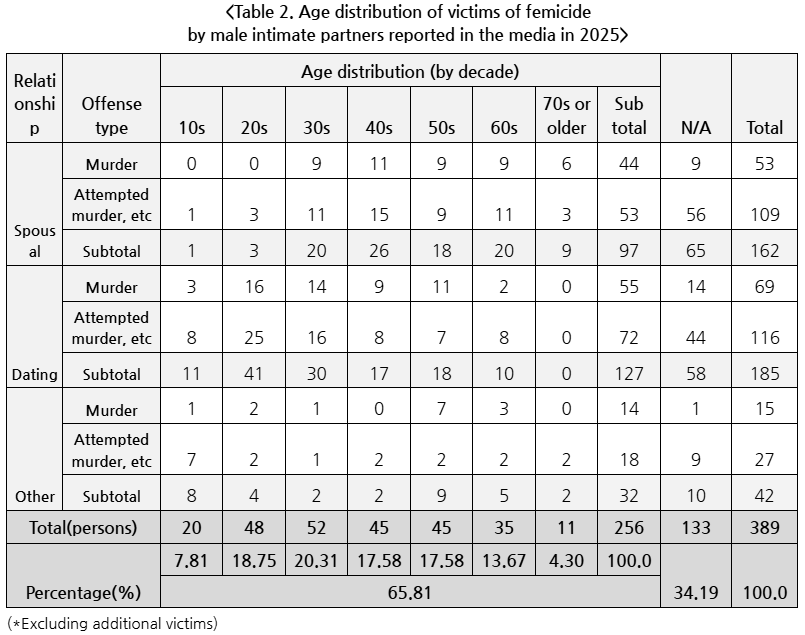
Of the 389 victims, 256 whose ages could be identified were analyzed. Victims in their thirties accounted for the largest share at 20.31% (52 victims), followed by those in their twenties at 18.75% (48 victims); those in their forties and fifties each accounted for 17.58% (45 victims); and those in their sixties accounted for 13.67% (35 victims). Victims in their teens accounted for 7.81% (20 victims), while those in their seventies and older accounted for 4.3% (11 victims).
At least 284 additional victims
in cases of femicide in intimate relationships
Violence against women in intimate relationships often does not end with harm to the victim, but frequently causes serious harm to family members, acquaintances, colleagues, pets, and third parties who intervene or attempt to stop the violence at the scene. Of the 673 cases reported in the media in 2025 involving femicide in intimate relationships, 284 cases (42.2%) involved harm to such additional victims.
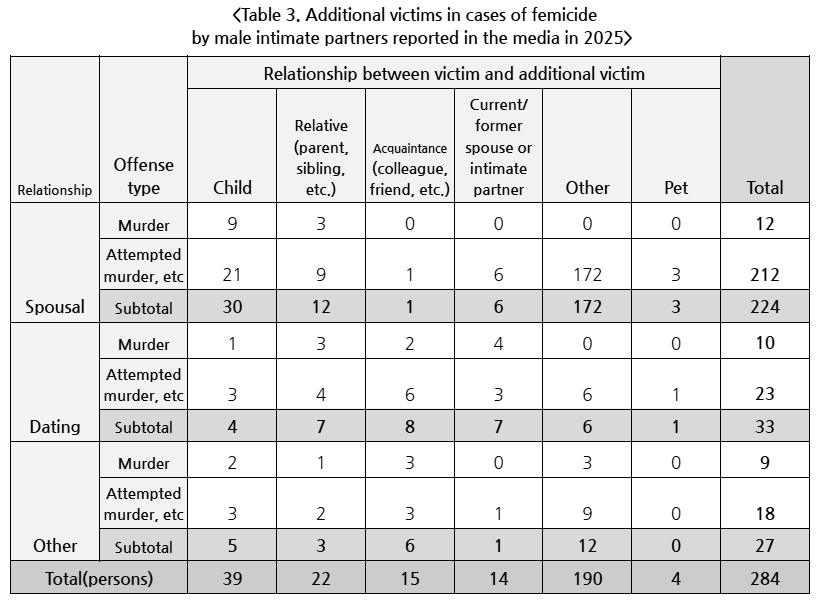
*Includes pets
** ‘Other’ includes bystanders and persons whom the perpetrator suspected of having an intimate relationship with the victim, among others.
Among spousal relationships, the largest number of additional victims fell into the “other” category, including bystanders and police officers: 172 out of 224 cases (76.8%). On the whole, “other” victims occur less frequently than children and similar categories, however, this year’s proportion was driven up by a single case involving 160 victims where the perpetrator, enraged by the outcome of divorce proceedings with the victim, set fire to a subway train and was detained and indicted on charges including attempted murder against 160 passengers. This case portrays the harmful reach of violence against women that extends harm beyond the victim’s immediate sphere and into society at large. Excluding this case, there were 64 additional victims in the spousal-relationship category, of whom children accounted for 30 (46.9%), followed by relatives such as parents and siblings (18.8%), former/current spouse or intimate partner (9.4%), pets (4.7%), and acquaintances such as colleagues and friends (1.6%).
In dating relationships, there were 33 additional victims, of whom acquaintances such as colleagues and friends accounted for the largest share at 8 victims (24.24%). Relatives such as parents and siblings, and current/former spouse or intimate partner, each accounted for 21.2%, followed by other victims including police officers (18.2%), children (12.1%), and pets (3.0%). Among the “other” victims were also cases in which police officers responding to a report were threatened with weapons and seriously injured, obstructing official duties and exposing members of the public to danger. In the other relationship category—including cases in which a man unilaterally sought a romantic or sexual relationship—there were 27 additional victims.
Pet victimization, which was included in the Gauge of Rage report since 2023, showed a similar pattern as in previous years. Cases in which perpetrators threw a pet dog out of a window while assaulting the victim, killed the family dog after assaulting the wife, or burned and abused the victim’s pet with a gas flame in front of the victim show that harm to pets in intimate partner violence functions as a means of inflicting suffering and exerting control over the victim. Yet punishment of perpetrators for such acts remains lacking. Very few shelters for victims where they can escape violence and rebuild their daily lives, allow admission with pets, and facilities able to care for companion animals during shelter stays are also extremely limited.
Women killed for “not celebrating his birthday,”
“talking in their sleep,” or “being ill”
“Because she didn’t celebrate my birthday”
“Because she said she didn’t know where the TV remote was”
“Because she talked in her sleep”
“Because she came home late”
“Because I had too much debt”
“Because she refused to sleep with me”
“Because she drank”
“Because she was ill”
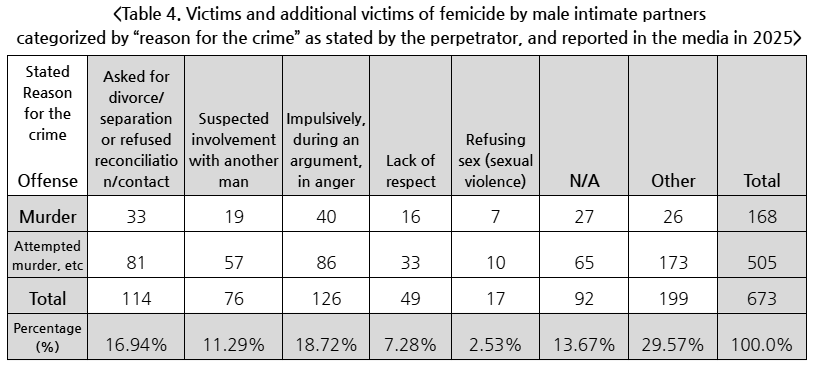
Analysis of the reasons for the crime mentioned by perpetrators in media reports shows that “other” reasons—including retaliation and debt-related motives—accounted for 199 cases, or 29.57% of the total. However, this too was heavily influenced by coverage of the earlier-mentioned subway arson case, involving the attempted murder of 160 additional victims. Excluding that case, among the remaining 515 cases, incidents classified as committed “in the heat of anger,” “during an argument,” or “impulsively” accounted for 126 cases, or 18.72%. Yet on closer examination, many of these cases cannot reasonably be understood as spontaneous responses to an interpersonal disagreement amongst equals. Such cases included: strangling a girlfriend for attempting to report the perpetrator’s violence to the police; beating a girlfriend with a blunt object because she said something he disliked in her sleep; killing the victim to prevent their extramarital intimate relationship from becoming known publicly; and threatening a wife with a knife because he disliked her chosen profession. All of these show that this violence is grounded in power imbalance and in the perpetrator’s posture toward the victim, treating her as property to be controlled and someone he can kill if he so chooses, rather than a human being to be respected.
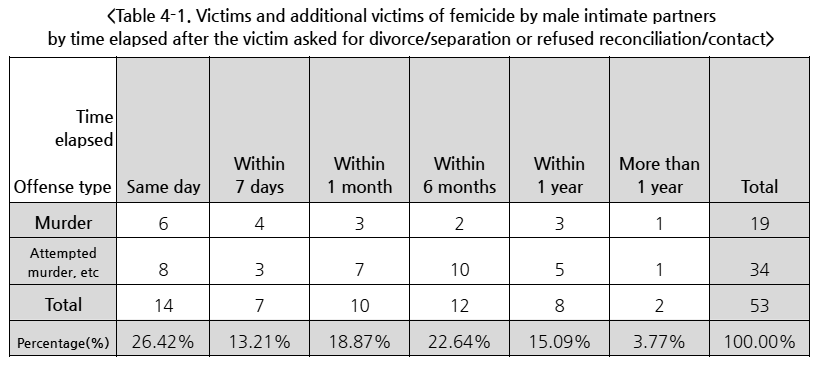
The next most common category was where perpetrators cited the fact that the victim had asked for divorce or separation, or refused reconciliation or contact, accounting for 114 victims (16.94%). Among these, there were 53 cases where the media specified the length of time between the victim’s expression of refusal and the occurrence of the offense. Analysis showed that the largest share occurred on the very same day the victim expressed her wish to separate or refused contact (26.4%), followed by within six months (22.64%), within one month (18.9%), within one year (15.1%), within seven days (13.21%), and one year or more later (3.8%). Regardless of the elapsed time, victims and additional victims were placed at risk because the victim had simply refused to continue the relationship. Other reasons cited included her suspected involvement with another man (76 victims, 14.76%) and because she “disrespected” him (49 victims, 9.51%). Perpetrators also killed additional victims for reasons such as “because they helped the victim,” “because they stopped me from approaching the victim,” “because they seemed close to the victim,” or “because they intervened in an argument with the victim.”
Home sweet home: the most dangerous place for women
Analysis of the locations where incidents occurred, as reported in the media, showed that violence in intimate relationships occurred most frequently at the victim’s residence (43.98%) and in vehicles or while in transit (27.19%). This was followed by “other” locations (21.4%), including the perpetrator’s residence, hotels, parking lots, and outdoor spaces, and then workplaces (7.43%).
Among these were cases in which perpetrators climbed gas pipes to enter the victim’s residence, disguised themselves as food delivery workers to gain entry and kill the victim, or tracked down and abducted a victim who had gone into hiding to escape him. These cases show that violence against women in intimate relationships penetrates the victim’s personal living space against her will, as it is characterized by the perpetrator’s use of the intimate relationship to obtain information about the victim’s residence, workplace, and other aspects of her everyday life. Perpetrators use this informational advantage to track victims, to continue acts of violence, and ultimately kill women who attempt to escape their control.
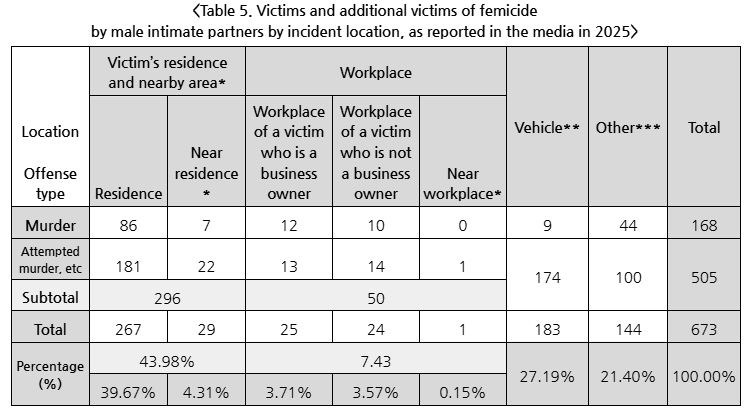
* “Nearby area” includes spaces in front of or on the way to the residence or workplace
**“Vehicle” includes the victim’s or perpetrator’s vehicle and, in rare cases, public transportation
***“Other” includes the perpetrator’s residence, hotels, parking lots, and outdoor spaces
86 victims and additional victims killed or placed at risk of being killed
despite police reports and victim-protection measures
—accounting for 12.8% of all victims
Of the 673 victims in this report who were killed or placed at risk of being killed, including additional victims, 86 persons (12.8%) had already reported to the police or were receiving victim-protection measures in order to be separated from the perpetrator. This is a devastating figure: even though victims recognized the danger of the violence and actively sought state intervention, that intervention failed to prevent femicide.
From January to August 2025, police applied for 5,849 temporary measures in domestic violence cases, but the courts approved only 4,623, or about 79%. Moreover, in most approved cases, the measures remained limited to relatively narrow interventions such as no-contact orders. The strongest protective measure—temporary measure number 5, namely detention of the perpetrator in a holding cell or detention center—was requested by police in only 493 cases, just 8% of the total. Of those, the court approved only 227, or about 46% of police requests, far below the overall approval rate of 79%.4)
These enforcement practices must be corrected immediately, given that even the protective measures already available under the current system are not being fully utilized. At the same time, the current Family Violence Punishment Act must also be amended, as it distinguishes between “domestic violence” and “domestic violence crimes” and allows protective measures to be enforced only in cases classified as the latter. By contrast, the Anti-Stalking Act is designed to allow state intervention even at the stage of stalking conduct, making preventive action possible before the conduct escalates into a criminal offense. Violence in intimate relationships likewise involves perpetrators invading the victim’s living sphere and repeating and escalating violence, making the need for early prevention equally urgent. In addition, the effectiveness of emergency measures and emergency temporary measures by judicial police officers must be guaranteed by ensuring that violations trigger immediate sanctions.
These enforcement practices must be corrected immediately, given that even the protective measures already available under the current system are not being fully utilized. The current Family Violence Punishment Act must also be amended, as it distinguishes between “domestic violence” and “domestic violence crimes” and allows protective measures to be enforced only in cases classified as the latter. By contrast, the Stalking Punishment Act is designed to allow state intervention even at the stage of stalking conduct, making preventive action possible before the conduct escalates into a criminal offense. Violence in intimate relationships likewise involves perpetrators invading the victim’s personal lives and repeating and escalating violence, making the need for early prevention equally urgent. In addition, the effectiveness of emergency measures and emergency temporary measures by judicial police officers must be guaranteed by ensuring that violations trigger immediate sanctions.
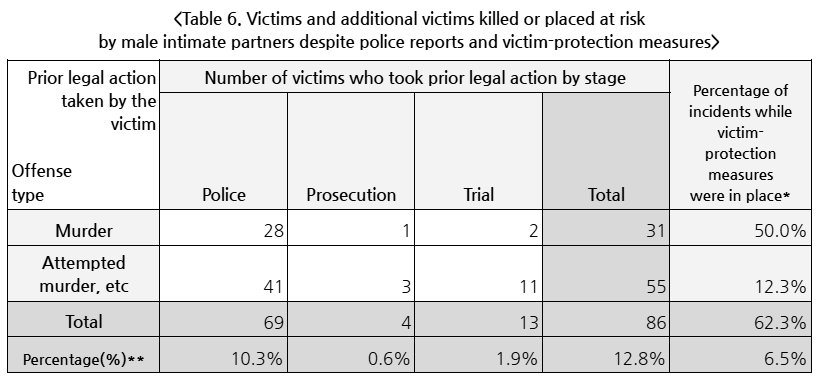
* “Victim-protection measures” refers to cases in which, prior to the lethal act of violence, the victim had been receiving emergency measures, temporary measures, victim protection orders, or provisional measures.
** The percentages indicate the proportion, among the 673 victims and additional victims, who were at the corresponding legal-response stage prior to the offense.
Perpetrator suicide: perpetrators choosing to evade legal responsibility,
and a legal framework that fails to stop it
This report compiled media-reported cases in which, after committing the lethal violence against the victim or additional victims, the perpetrator attempted or died by suicide. Among all cases, there were 44 incidents in which the perpetrator either died by suicide or attempted suicide. These included cases in which the perpetrator died after a standoff with responding police, cases in which he killed his wife and family and survived alone, and cases in which he killed the victim and then died by jumping from a height or hanging himself. There was even a case in which the perpetrator engaged in self-harm after killing the victim and later claimed diminished capacity in court.
However, in crimes of violence against women in intimate relationships, perpetrator suicide is not simply a death of one individual. Under current law, when a suspect dies during an investigation, investigative authorities close the case for lack of prosecutorial authority. The perpetrator’s choice to die by suicide after taking the victim’s life is a final act of evading legal responsibility, and depriving the bereaved family not only of the victim’s life but also of any opportunity to achieve justice through the legal system. Legal and institutional reform is needed so that, even when a suspect in an intimate partner violence case has died, investigative authorities can officially establish the facts of the case and the context of the harm at the request of the victim or legal representative.
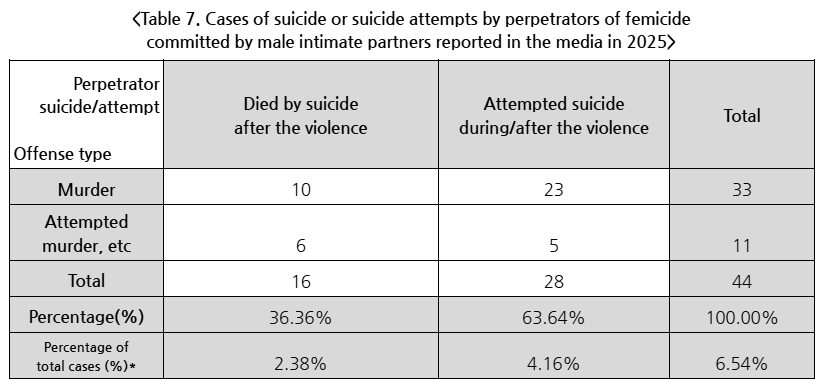
*Share of cases where the perpetrator attempted and/or died by suicide among all 673 victims and additional victims of femicide committed by male intimate partner
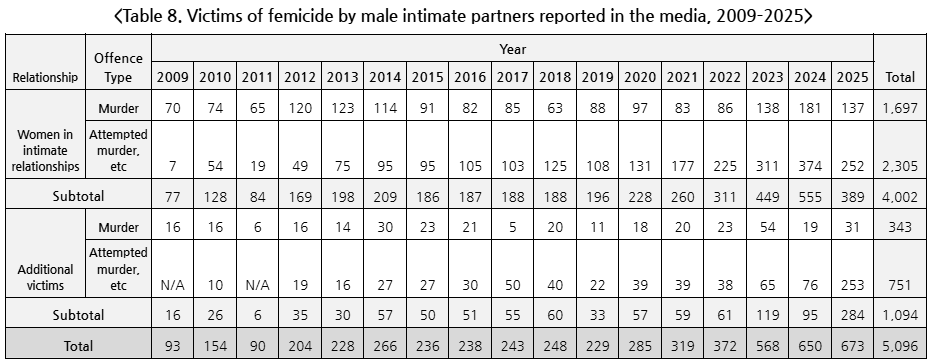
At least 1,697 women have been killed by male intimate partners;
4,002 including attempts, and 5,096 including additional victims
over the past 17 years
From 2009 to 2025, at least 1,697 women reported in the media were killed by a male intimate partner. Including attempted murder and related cases, the total rises to 4,002; including additional victims, it reaches 5,096. In other words, over the past 17 years, at least one woman every 1.55 days has been killed or placed at risk of being killed by a male intimate partner. Yet comprehensive official statistics that reveal the scale and patterns of femicide in intimate relationships in a multidimensional way still do not exist.
II. Analysis of Femicide by Men Previously Unknown to the Victim
Based on Media Reports
In 2025, at least one woman every 3.98 days was killed by a man previously unknown to her. These figures count only cases reported in the media and therefore represent the minimum number of incidents known to have occurred. In this report, femicide by a man previously unknown to the victim is limited to cases in which the victim and perpetrator met for the first time. Cases involving acquaintances such as neighbors, schoolmates, or co-workers, as well as cases in which media reports did not provide sufficient information about the relationship between victim and perpetrator, have been excluded.
- 94 victims of femicide by men previously unknown to the victim,
including additional victims
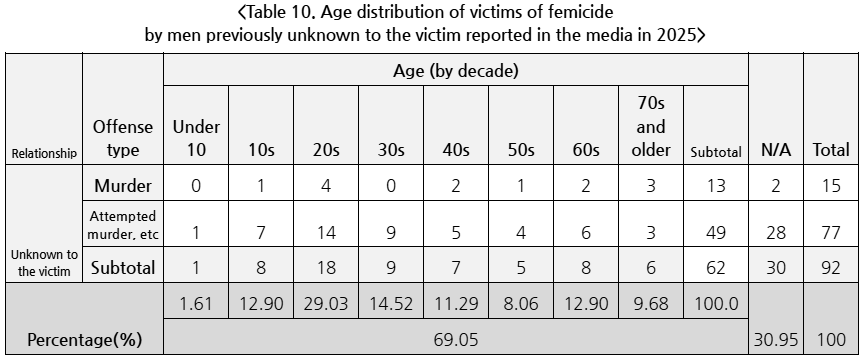
- Victims found across all age groups, highest among their twenties
Analysis of media-reported cases in 2025 found a total of 94 victims, including additional victims, in cases of femicide by men previously unknown to the victim. Victimization was found across all age groups, though women in their 20s accounted for a relatively high share at 18 victims (29.03%).
In 2025, there were also multiple incidents involving threats of mass attacks targeting women by men previously unknown to them. In one case, threatening emails claiming that explosives had been planted at two women’s universities in July prompted police searches and emergency evacuations of students. In another case, a perpetrator posted a total of 14 threat messages, including threats to kill women, leading to the deployment of more than 800 police officers at the scene. These incidents are difficult to quantify and were excluded from the above figures. Yet had the threats been carried out unchecked, they could have caused large-scale harm to the targeted women and additional victims.
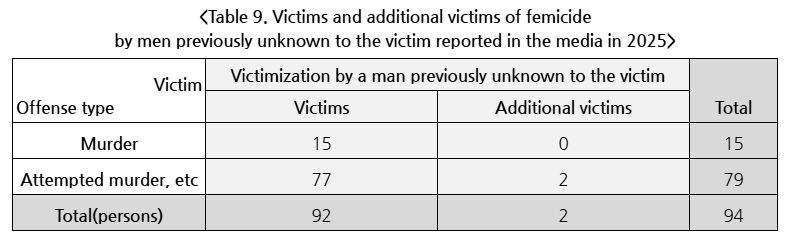
*Additional victims: acquaintances or bystanders attempting to stop the crime, or police officers responding to reports, etc.
Women killed or threatened simply for being women—
while working, while waiting for a bus, or walking down the street
“Because she looked down on me”
“Because she refused to have sex with me”
“Because she was too loud”
“Because she told me to be quiet in a public place”
“Because I was in a bad mood”
“Just because”
Perpetrators killed women previously unknown to them while invoking such “reasons.” Women suddenly became victims of violence while working, waiting for a bus, walking down the street, or simply going about their daily lives—targeted for no reason other than that they were women.
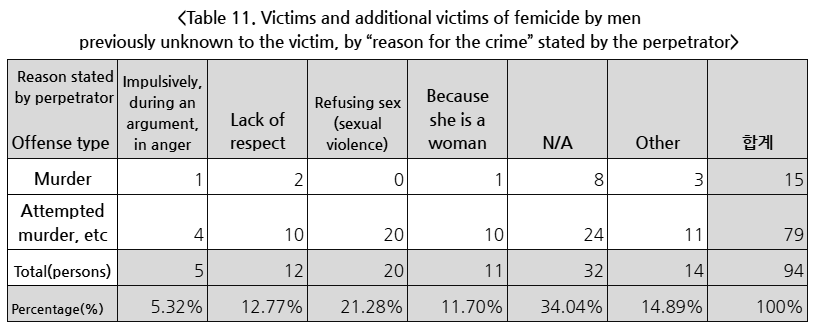
*Attempted sexual violence includes cases in which the perpetrator committed the offense in order to subdue the victim for sexual violence, or killed a victim who resisted sexual violence, etc.
The largest share among the reasons cited by perpetrators was attempted sexual violence (21.28%). This was followed by other reasons (14.89%), including ‘reasons’ such as “just because,” “because I wanted to assault someone,” “because she was too loud,” or claims of diminished capacity. Other cited reasons included “because she disrespected me” (12.77%), “because she was a woman” (11.7%), and claims that the offense was committed in the heat of anger, during an argument, or impulsively (5.32%).
Perpetrators attempted sexual violence against women previously unknown to them and, when victims resisted, inflicted serious injury or took their lives. They also committed indiscriminate violence against women simply because they were women. This shows that such crimes are grounded in sexist discriminatory attitudes that view women as targets of sexual violence and as persons over whom men may act at will.
III. Recommendations
The State’s Obligations to Address Continuing Femicide: Comprehensive Strengthening of Statistics, Legislation, Punishment, and Protection Systems, and the Development of an Integrated National Response
Widespread femicide produced by structural gender discrimination
Violence against women is not a matter of individual misfortune or isolated impulsive acts. It is violence that arises, is reinforced, and is repeated within sociocultural conditions structured by gender discrimination. The reality that hundreds of women lose their lives every year, without any marked reduction in scale, demonstrates that sexist culture and attitudes remain deeply entrenched in our society and that progress toward gender equality has been inadequate. According to the Gender Social Norms Index (GSNI) released by UNDP in 2023, South Korea was identified as one of the 37 surveyed countries where gender bias had worsened significantly. In this context, what has changed nearly one year after the launch of the new “People’s SovereignGovernment,” formed through the efforts of citizens who hoped for gender-equal politics after the Yoon Suk Yeol administration—which denied the existence of structural gender discrimination and gravely rolled back democracy—was impeached in early 2025? Although the ministerial post responsible for gender equality policy, which had been vacant for 19 months, was finally filled and the ministry was expanded and reorganized into the Ministry of Gender Equality and Family, the current government continues to face criticism for what appears to be an effort to place the elimination of so-called “reverse discrimination against men” at the center of gender equality policy, reflecting a lack of understanding of structural gender discrimination and an insufficient gender equality perspective. How should the worsening problem of femicide be addressed in the face of this regressive reality?
The state’s commitment to ending femicide
must begin with the quality of its statistics
An accurate understanding of the situation is essential to solving any problem. In December 2025, pursuant to the Framework Act on the Prevention of Violence Against Women, the Ministry of Gender Equality and Family released the 2025 Statistics on Violence Against Women, including data on homicide, manslaughter, and violence in intimate relationships. Yet these statistics remain insufficient to comprehensively reveal the realities of femicide in intimate relationships. Said report is limited to relationships among current or former spouses (including common-law spouses) and current or former dating partners, making it highly likely that crimes arising in broader forms of intimate relationships—such as those formed through dating apps or cases involving unilateral demands for a relationship—are not adequately included. In addition, cases along the continuum and in the context of femicide are not adequately captured, including deaths caused by violence not legally classified as manslaughter, cases in which the victim died by suicide as a result of the perpetrator’s violence, cases in which the perpetrator died by suicide after the killing, and contextual indicators such as prior police reporting and histories of victim-protection measures. By contrast, the United Kingdom operates a Domestic Homicide Review system covering deaths of victims of violence in intimate relationships, including suicides, and uses it to concretely identify where the state failed to protect the victim and to reflect those findings in policy reform. The need for such a public review mechanism has also been raised consistently in Korea, and two related bills have now been introduced.5) Meanwhile, statistics on femicide committed by men previously unknown to the victim are also absent from the 2025 Statistics on Violence Against Women.
Statistics intended to understand the reality of the problem should not be a mere enumeration of numbers; they must point toward solutions. In November 2025, UN Office on Drugs and Crime (UNODC) and UN Women stated in their Femicides in 2024 report that a state’s commitment to eradicating femicide is reflected in the quality and availability of its statistics. Current national statistics in Korea remain limited to crime-trend data provided by the National Police Agency, and urgent improvement is needed.
Not by amending the Stalking Punishment Act, but
Towards a comprehensive legislation on violence in intimate relationships
What is urgently needed on the legislative front is not a piecemeal supplementation but a redesign of law and institutions governing violence against women in intimate relationships as a whole, centered on guaranteeing victims’ rights. The current system is fragmented in its treatment of domestic violence and dating violence and has been tilted toward preserving relationships and reforming perpetrators, while failing to adequately guarantee victim protection and active state intervention. As a result, victims have been left exposed to repeated violence and the risk of femicide even after reporting abuse and requesting protection.
Legislation on violence in intimate relationships reflective of reality cannot stop at simply adding dating violence as a separate issue. Through a comprehensive revision of the Family Violence Punishment Act, the concept of intimate relationship must be clearly defined to encompass all forms of intimate relationships, including spousal relationships, dating relationships, ongoing sexual relationships, and cohabiting relationships, etc. The aim of the law must also shift away from preserving relationships and toward guaranteeing victims’ human rights and preserving the freedom to shape their lives. In this regard, the Ministry of Justice’s plan to legislate dating violence by forcing it into the framework of the Stalking Punishment Act—which regulates forms of conduct rather than addressing the nature of violence against women in intimate relationships—amounts to little more than a legislatively convenient approach and must immediately be reconsidered.
No further delay: state responsibility must be implemented now
Violence against women in intimate relationships can no longer be left to the realm of private conflict or treated as isolated incidents. It is a grave matter requiring state intervention and accountability, and a structural problem that directly infringes women’s right to life and human rights. The state can no longer leave victims in a situation where they repeatedly seek help and are still killed or placed at risk of being killed. Building more precise and comprehensive femicide statistics, promptly enacting and amending relevant laws, and developing integrated measures that ensure the effectiveness of victim-protection mechanisms are not optional. They are obligations the state must fulfill immediately.
1) The term femicide is used to refer to both murders and attempted murders.
2) A total of 38 volunteer activists participated in the analysis for the 2025 Gauge of Rage.
3) UN Committee on the Elimination of Discrimination against Women, Concluding observations on the ninth periodic report of the Republic of Korea, 2024, UN Doc. CEDAW/C/KOR/CO/9, para. 55.
4) Data provided by the Korean National Police Agency to the Office of Assembly Member Yong Hye-in, 2025.
5) Bill for Partial Amendment of the Act on Prevention of Domestic Violence and Protection, etc. of Victims, proposed by Assembly Member Jeon Jin-sook and 12 others (11 June 2025); Bill for Partial Amendment of the Act on Prevention of Domestic Violence and Protection, etc. of Victims, proposed by Assembly Member Kim Yong-man and 12 others (30 June 2025).
| Korea Women’s Hot-Line has, since 2009, made known the grave state of violence against women by releasing statistics on women killed by male intimate partners in marital or dating relationships based on an analysis of cases reported in the media. From 2023 to 2025, the report has also included an analysis of femicide committed by men previously unknown to the victim. |
* A total of 38 volunteer activists participated in the analysis for the 2025 Gauge of Rage.
강준아 강푸름 김령아 김주희 김현아 녕 단단(고은정) 도원 루니(남하님) 류하연 리미 小菊 신동효 신미혜 앨리스 양경미 영경 영은 오예린 유경화 유서현 이지우 장이율은 정인아 정주영 조경숙(갱) 지연 진영인 최보라 최지은 한나 한예은 해연 혜린 황유선 hypsen Joha JUDY |


2025 Gauge of Rage
An Analysis of Femicide1) committed by Male Intimate Partners
and by Men Unknown to the Victim, Based on Media Reports2)
In 2025, at least 137 women were killed in the context of intimate relationships,
389 victims including attempted murder and related cases,
and 673 victims including additional victims.
In cases of women killed by men previously unknown to them,
there were 94 victims including additional victims.
These figures represent only the minimum known number of femicides.
Since 2009, Korea Women’s Hot-Line has annually published a report titled the “Gauge of Rage”, an analysis of women killed by male intimate partners based on media reports. This was intended both to remember the victims and to expose the gravity of violence against women, while also urging the government to establish official statistics that can serve as a policy foundation for addressing the problem. However, this report reflects only the minimum number of incidents known to have occurred, as this report analyzes only cases reported in the media. Moreover, because the scope of analysis is limited to intimate relationships and relationships with men previously unknown to the victim, it does not include femicides occurring in other relational contexts such as workplaces, schools, or neighborhoods, etc. The figures in this report therefore do not reflect the full reality of femicide in South Korean society. The absence of such official statistics, and the need to establish them, has also been repeatedly raised in recommendations to the Korean government by the international community.3)
In December 2025, the Ministry of Gender Equality and Family(MOGEF) announced, with the release of the 「2025 Statistics on Violence Against Women」, that it had for the first time compiled statistics capable of identifying the status of homicide, manslaughter, and violence in intimate relationships. While the launch of official statistics attempting to quantify femicide is welcome, these statistics remain insufficient to comprehensively reveal the realities of femicide in intimate relationships. For example, they do not adequately capture cases in the full context of intimate partner violence, such as deaths caused by violence that are not legally classified as manslaughter, or cases in which the perpetrator dies by suicide after the killing and the case is closed for lack of prosecutorial authority.
Thus, even now, in the 17th year since the Gauge of Rage began reporting these figures, comprehensive official statistics that present the scale and patterns of femicide in intimate relationships in a multidimensional way remain absent. In its 2025 Gauge of Rage report, Korea Women’s Hot-Line therefore analyzed femicide in intimate relationships and femicide by men previously unknown to the victim as indicators that expose this reality.
Ⅰ. Analysis of Femicide by Male Intimate Partners Based on Media Reports
In 2025, at least 137 women were killed in intimate relationships,
389 victims including attempted murders and related cases
According to Korea Women’s Hot-Line’s analysis of incidents reported in the media between January 1 and December 31, 2025, at least 137 women were killed by a male intimate partner such as a husband or boyfriend, and at least 252 women survived an attempted murder or related lethal violence by such a partner. When additional victims such as the victim’s children, parents, and friends are included, the total number of victims killed or placed at risk of being killed by a male intimate partner reached at least 673. This means that, at a minimum, one woman every 22.5 hours was killed or placed at risk of being killed by a husband, boyfriend, or other male intimate partner. Including additional victims, one person every 13.02 hours was victimized. However, because these figures represent only the minimum number of cases reported in the media, the actual number of women killed or placed at risk of being killed by male intimate partners is likely to be far higher.
*Spousal relationship: includes past or current spouses, including those in common-law marriage
*Dating relationship: includes past or current dating relationship, including cohabitation, relationships formed by blind dates, dating applications, forum chats, transactional arrangement, etc.
*Other: relationships outside of dating and marriage, including cases where the perpetrator unilaterally seeks a romantic or sexual relationship
*Additional victims: includes the victim’s children, etc. Pet victimization is also included in this category; although the unit is standardized as “persons,” incidents are occasionally referred to as “cases” where context requires.
Femicide by male intimate partners occurred across all age groups
Of the 389 victims, 256 whose ages could be identified were analyzed. Victims in their thirties accounted for the largest share at 20.31% (52 victims), followed by those in their twenties at 18.75% (48 victims); those in their forties and fifties each accounted for 17.58% (45 victims); and those in their sixties accounted for 13.67% (35 victims). Victims in their teens accounted for 7.81% (20 victims), while those in their seventies and older accounted for 4.3% (11 victims).
At least 284 additional victims
in cases of femicide in intimate relationships
Violence against women in intimate relationships often does not end with harm to the victim, but frequently causes serious harm to family members, acquaintances, colleagues, pets, and third parties who intervene or attempt to stop the violence at the scene. Of the 673 cases reported in the media in 2025 involving femicide in intimate relationships, 284 cases (42.2%) involved harm to such additional victims.
*Includes pets
** ‘Other’ includes bystanders and persons whom the perpetrator suspected of having an intimate relationship with the victim, among others.
Among spousal relationships, the largest number of additional victims fell into the “other” category, including bystanders and police officers: 172 out of 224 cases (76.8%). On the whole, “other” victims occur less frequently than children and similar categories, however, this year’s proportion was driven up by a single case involving 160 victims where the perpetrator, enraged by the outcome of divorce proceedings with the victim, set fire to a subway train and was detained and indicted on charges including attempted murder against 160 passengers. This case portrays the harmful reach of violence against women that extends harm beyond the victim’s immediate sphere and into society at large. Excluding this case, there were 64 additional victims in the spousal-relationship category, of whom children accounted for 30 (46.9%), followed by relatives such as parents and siblings (18.8%), former/current spouse or intimate partner (9.4%), pets (4.7%), and acquaintances such as colleagues and friends (1.6%).
In dating relationships, there were 33 additional victims, of whom acquaintances such as colleagues and friends accounted for the largest share at 8 victims (24.24%). Relatives such as parents and siblings, and current/former spouse or intimate partner, each accounted for 21.2%, followed by other victims including police officers (18.2%), children (12.1%), and pets (3.0%). Among the “other” victims were also cases in which police officers responding to a report were threatened with weapons and seriously injured, obstructing official duties and exposing members of the public to danger. In the other relationship category—including cases in which a man unilaterally sought a romantic or sexual relationship—there were 27 additional victims.
Pet victimization, which was included in the Gauge of Rage report since 2023, showed a similar pattern as in previous years. Cases in which perpetrators threw a pet dog out of a window while assaulting the victim, killed the family dog after assaulting the wife, or burned and abused the victim’s pet with a gas flame in front of the victim show that harm to pets in intimate partner violence functions as a means of inflicting suffering and exerting control over the victim. Yet punishment of perpetrators for such acts remains lacking. Very few shelters for victims where they can escape violence and rebuild their daily lives, allow admission with pets, and facilities able to care for companion animals during shelter stays are also extremely limited.
Women killed for “not celebrating his birthday,”
“talking in their sleep,” or “being ill”
“Because she didn’t celebrate my birthday”
“Because she said she didn’t know where the TV remote was”
“Because she talked in her sleep”
“Because she came home late”
“Because I had too much debt”
“Because she refused to sleep with me”
“Because she drank”
“Because she was ill”

Analysis of the reasons for the crime mentioned by perpetrators in media reports shows that “other” reasons—including retaliation and debt-related motives—accounted for 199 cases, or 29.57% of the total. However, this too was heavily influenced by coverage of the earlier-mentioned subway arson case, involving the attempted murder of 160 additional victims. Excluding that case, among the remaining 515 cases, incidents classified as committed “in the heat of anger,” “during an argument,” or “impulsively” accounted for 126 cases, or 18.72%. Yet on closer examination, many of these cases cannot reasonably be understood as spontaneous responses to an interpersonal disagreement amongst equals. Such cases included: strangling a girlfriend for attempting to report the perpetrator’s violence to the police; beating a girlfriend with a blunt object because she said something he disliked in her sleep; killing the victim to prevent their extramarital intimate relationship from becoming known publicly; and threatening a wife with a knife because he disliked her chosen profession. All of these show that this violence is grounded in power imbalance and in the perpetrator’s posture toward the victim, treating her as property to be controlled and someone he can kill if he so chooses, rather than a human being to be respected.
The next most common category was where perpetrators cited the fact that the victim had asked for divorce or separation, or refused reconciliation or contact, accounting for 114 victims (16.94%). Among these, there were 53 cases where the media specified the length of time between the victim’s expression of refusal and the occurrence of the offense. Analysis showed that the largest share occurred on the very same day the victim expressed her wish to separate or refused contact (26.4%), followed by within six months (22.64%), within one month (18.9%), within one year (15.1%), within seven days (13.21%), and one year or more later (3.8%). Regardless of the elapsed time, victims and additional victims were placed at risk because the victim had simply refused to continue the relationship. Other reasons cited included her suspected involvement with another man (76 victims, 14.76%) and because she “disrespected” him (49 victims, 9.51%). Perpetrators also killed additional victims for reasons such as “because they helped the victim,” “because they stopped me from approaching the victim,” “because they seemed close to the victim,” or “because they intervened in an argument with the victim.”
Home sweet home: the most dangerous place for women
Analysis of the locations where incidents occurred, as reported in the media, showed that violence in intimate relationships occurred most frequently at the victim’s residence (43.98%) and in vehicles or while in transit (27.19%). This was followed by “other” locations (21.4%), including the perpetrator’s residence, hotels, parking lots, and outdoor spaces, and then workplaces (7.43%).
Among these were cases in which perpetrators climbed gas pipes to enter the victim’s residence, disguised themselves as food delivery workers to gain entry and kill the victim, or tracked down and abducted a victim who had gone into hiding to escape him. These cases show that violence against women in intimate relationships penetrates the victim’s personal living space against her will, as it is characterized by the perpetrator’s use of the intimate relationship to obtain information about the victim’s residence, workplace, and other aspects of her everyday life. Perpetrators use this informational advantage to track victims, to continue acts of violence, and ultimately kill women who attempt to escape their control.
* “Nearby area” includes spaces in front of or on the way to the residence or workplace
**“Vehicle” includes the victim’s or perpetrator’s vehicle and, in rare cases, public transportation
***“Other” includes the perpetrator’s residence, hotels, parking lots, and outdoor spaces
86 victims and additional victims killed or placed at risk of being killed
despite police reports and victim-protection measures
—accounting for 12.8% of all victims
Of the 673 victims in this report who were killed or placed at risk of being killed, including additional victims, 86 persons (12.8%) had already reported to the police or were receiving victim-protection measures in order to be separated from the perpetrator. This is a devastating figure: even though victims recognized the danger of the violence and actively sought state intervention, that intervention failed to prevent femicide.
From January to August 2025, police applied for 5,849 temporary measures in domestic violence cases, but the courts approved only 4,623, or about 79%. Moreover, in most approved cases, the measures remained limited to relatively narrow interventions such as no-contact orders. The strongest protective measure—temporary measure number 5, namely detention of the perpetrator in a holding cell or detention center—was requested by police in only 493 cases, just 8% of the total. Of those, the court approved only 227, or about 46% of police requests, far below the overall approval rate of 79%.4)
These enforcement practices must be corrected immediately, given that even the protective measures already available under the current system are not being fully utilized. At the same time, the current Family Violence Punishment Act must also be amended, as it distinguishes between “domestic violence” and “domestic violence crimes” and allows protective measures to be enforced only in cases classified as the latter. By contrast, the Anti-Stalking Act is designed to allow state intervention even at the stage of stalking conduct, making preventive action possible before the conduct escalates into a criminal offense. Violence in intimate relationships likewise involves perpetrators invading the victim’s living sphere and repeating and escalating violence, making the need for early prevention equally urgent. In addition, the effectiveness of emergency measures and emergency temporary measures by judicial police officers must be guaranteed by ensuring that violations trigger immediate sanctions.
These enforcement practices must be corrected immediately, given that even the protective measures already available under the current system are not being fully utilized. The current Family Violence Punishment Act must also be amended, as it distinguishes between “domestic violence” and “domestic violence crimes” and allows protective measures to be enforced only in cases classified as the latter. By contrast, the Stalking Punishment Act is designed to allow state intervention even at the stage of stalking conduct, making preventive action possible before the conduct escalates into a criminal offense. Violence in intimate relationships likewise involves perpetrators invading the victim’s personal lives and repeating and escalating violence, making the need for early prevention equally urgent. In addition, the effectiveness of emergency measures and emergency temporary measures by judicial police officers must be guaranteed by ensuring that violations trigger immediate sanctions.
* “Victim-protection measures” refers to cases in which, prior to the lethal act of violence, the victim had been receiving emergency measures, temporary measures, victim protection orders, or provisional measures.
** The percentages indicate the proportion, among the 673 victims and additional victims, who were at the corresponding legal-response stage prior to the offense.
Perpetrator suicide: perpetrators choosing to evade legal responsibility,
and a legal framework that fails to stop it
This report compiled media-reported cases in which, after committing the lethal violence against the victim or additional victims, the perpetrator attempted or died by suicide. Among all cases, there were 44 incidents in which the perpetrator either died by suicide or attempted suicide. These included cases in which the perpetrator died after a standoff with responding police, cases in which he killed his wife and family and survived alone, and cases in which he killed the victim and then died by jumping from a height or hanging himself. There was even a case in which the perpetrator engaged in self-harm after killing the victim and later claimed diminished capacity in court.
However, in crimes of violence against women in intimate relationships, perpetrator suicide is not simply a death of one individual. Under current law, when a suspect dies during an investigation, investigative authorities close the case for lack of prosecutorial authority. The perpetrator’s choice to die by suicide after taking the victim’s life is a final act of evading legal responsibility, and depriving the bereaved family not only of the victim’s life but also of any opportunity to achieve justice through the legal system. Legal and institutional reform is needed so that, even when a suspect in an intimate partner violence case has died, investigative authorities can officially establish the facts of the case and the context of the harm at the request of the victim or legal representative.
*Share of cases where the perpetrator attempted and/or died by suicide among all 673 victims and additional victims of femicide committed by male intimate partner
At least 1,697 women have been killed by male intimate partners;
4,002 including attempts, and 5,096 including additional victims
over the past 17 years
From 2009 to 2025, at least 1,697 women reported in the media were killed by a male intimate partner. Including attempted murder and related cases, the total rises to 4,002; including additional victims, it reaches 5,096. In other words, over the past 17 years, at least one woman every 1.55 days has been killed or placed at risk of being killed by a male intimate partner. Yet comprehensive official statistics that reveal the scale and patterns of femicide in intimate relationships in a multidimensional way still do not exist.
II. Analysis of Femicide by Men Previously Unknown to the Victim
Based on Media Reports
In 2025, at least one woman every 3.98 days was killed by a man previously unknown to her. These figures count only cases reported in the media and therefore represent the minimum number of incidents known to have occurred. In this report, femicide by a man previously unknown to the victim is limited to cases in which the victim and perpetrator met for the first time. Cases involving acquaintances such as neighbors, schoolmates, or co-workers, as well as cases in which media reports did not provide sufficient information about the relationship between victim and perpetrator, have been excluded.
- 94 victims of femicide by men previously unknown to the victim,
including additional victims
- Victims found across all age groups, highest among their twenties
Analysis of media-reported cases in 2025 found a total of 94 victims, including additional victims, in cases of femicide by men previously unknown to the victim. Victimization was found across all age groups, though women in their 20s accounted for a relatively high share at 18 victims (29.03%).
In 2025, there were also multiple incidents involving threats of mass attacks targeting women by men previously unknown to them. In one case, threatening emails claiming that explosives had been planted at two women’s universities in July prompted police searches and emergency evacuations of students. In another case, a perpetrator posted a total of 14 threat messages, including threats to kill women, leading to the deployment of more than 800 police officers at the scene. These incidents are difficult to quantify and were excluded from the above figures. Yet had the threats been carried out unchecked, they could have caused large-scale harm to the targeted women and additional victims.
*Additional victims: acquaintances or bystanders attempting to stop the crime, or police officers responding to reports, etc.
Women killed or threatened simply for being women—
while working, while waiting for a bus, or walking down the street
“Because she looked down on me”
“Because she refused to have sex with me”
“Because she was too loud”
“Because she told me to be quiet in a public place”
“Because I was in a bad mood”
“Just because”
Perpetrators killed women previously unknown to them while invoking such “reasons.” Women suddenly became victims of violence while working, waiting for a bus, walking down the street, or simply going about their daily lives—targeted for no reason other than that they were women.
*Attempted sexual violence includes cases in which the perpetrator committed the offense in order to subdue the victim for sexual violence, or killed a victim who resisted sexual violence, etc.
The largest share among the reasons cited by perpetrators was attempted sexual violence (21.28%). This was followed by other reasons (14.89%), including ‘reasons’ such as “just because,” “because I wanted to assault someone,” “because she was too loud,” or claims of diminished capacity. Other cited reasons included “because she disrespected me” (12.77%), “because she was a woman” (11.7%), and claims that the offense was committed in the heat of anger, during an argument, or impulsively (5.32%).
Perpetrators attempted sexual violence against women previously unknown to them and, when victims resisted, inflicted serious injury or took their lives. They also committed indiscriminate violence against women simply because they were women. This shows that such crimes are grounded in sexist discriminatory attitudes that view women as targets of sexual violence and as persons over whom men may act at will.
III. Recommendations
The State’s Obligations to Address Continuing Femicide: Comprehensive Strengthening of Statistics, Legislation, Punishment, and Protection Systems, and the Development of an Integrated National Response
Widespread femicide produced by structural gender discrimination
Violence against women is not a matter of individual misfortune or isolated impulsive acts. It is violence that arises, is reinforced, and is repeated within sociocultural conditions structured by gender discrimination. The reality that hundreds of women lose their lives every year, without any marked reduction in scale, demonstrates that sexist culture and attitudes remain deeply entrenched in our society and that progress toward gender equality has been inadequate. According to the Gender Social Norms Index (GSNI) released by UNDP in 2023, South Korea was identified as one of the 37 surveyed countries where gender bias had worsened significantly. In this context, what has changed nearly one year after the launch of the new “People’s SovereignGovernment,” formed through the efforts of citizens who hoped for gender-equal politics after the Yoon Suk Yeol administration—which denied the existence of structural gender discrimination and gravely rolled back democracy—was impeached in early 2025? Although the ministerial post responsible for gender equality policy, which had been vacant for 19 months, was finally filled and the ministry was expanded and reorganized into the Ministry of Gender Equality and Family, the current government continues to face criticism for what appears to be an effort to place the elimination of so-called “reverse discrimination against men” at the center of gender equality policy, reflecting a lack of understanding of structural gender discrimination and an insufficient gender equality perspective. How should the worsening problem of femicide be addressed in the face of this regressive reality?
The state’s commitment to ending femicide
must begin with the quality of its statistics
An accurate understanding of the situation is essential to solving any problem. In December 2025, pursuant to the Framework Act on the Prevention of Violence Against Women, the Ministry of Gender Equality and Family released the 2025 Statistics on Violence Against Women, including data on homicide, manslaughter, and violence in intimate relationships. Yet these statistics remain insufficient to comprehensively reveal the realities of femicide in intimate relationships. Said report is limited to relationships among current or former spouses (including common-law spouses) and current or former dating partners, making it highly likely that crimes arising in broader forms of intimate relationships—such as those formed through dating apps or cases involving unilateral demands for a relationship—are not adequately included. In addition, cases along the continuum and in the context of femicide are not adequately captured, including deaths caused by violence not legally classified as manslaughter, cases in which the victim died by suicide as a result of the perpetrator’s violence, cases in which the perpetrator died by suicide after the killing, and contextual indicators such as prior police reporting and histories of victim-protection measures. By contrast, the United Kingdom operates a Domestic Homicide Review system covering deaths of victims of violence in intimate relationships, including suicides, and uses it to concretely identify where the state failed to protect the victim and to reflect those findings in policy reform. The need for such a public review mechanism has also been raised consistently in Korea, and two related bills have now been introduced.5) Meanwhile, statistics on femicide committed by men previously unknown to the victim are also absent from the 2025 Statistics on Violence Against Women.
Statistics intended to understand the reality of the problem should not be a mere enumeration of numbers; they must point toward solutions. In November 2025, UN Office on Drugs and Crime (UNODC) and UN Women stated in their Femicides in 2024 report that a state’s commitment to eradicating femicide is reflected in the quality and availability of its statistics. Current national statistics in Korea remain limited to crime-trend data provided by the National Police Agency, and urgent improvement is needed.
Not by amending the Stalking Punishment Act, but
Towards a comprehensive legislation on violence in intimate relationships
What is urgently needed on the legislative front is not a piecemeal supplementation but a redesign of law and institutions governing violence against women in intimate relationships as a whole, centered on guaranteeing victims’ rights. The current system is fragmented in its treatment of domestic violence and dating violence and has been tilted toward preserving relationships and reforming perpetrators, while failing to adequately guarantee victim protection and active state intervention. As a result, victims have been left exposed to repeated violence and the risk of femicide even after reporting abuse and requesting protection.
Legislation on violence in intimate relationships reflective of reality cannot stop at simply adding dating violence as a separate issue. Through a comprehensive revision of the Family Violence Punishment Act, the concept of intimate relationship must be clearly defined to encompass all forms of intimate relationships, including spousal relationships, dating relationships, ongoing sexual relationships, and cohabiting relationships, etc. The aim of the law must also shift away from preserving relationships and toward guaranteeing victims’ human rights and preserving the freedom to shape their lives. In this regard, the Ministry of Justice’s plan to legislate dating violence by forcing it into the framework of the Stalking Punishment Act—which regulates forms of conduct rather than addressing the nature of violence against women in intimate relationships—amounts to little more than a legislatively convenient approach and must immediately be reconsidered.
No further delay: state responsibility must be implemented now
Violence against women in intimate relationships can no longer be left to the realm of private conflict or treated as isolated incidents. It is a grave matter requiring state intervention and accountability, and a structural problem that directly infringes women’s right to life and human rights. The state can no longer leave victims in a situation where they repeatedly seek help and are still killed or placed at risk of being killed. Building more precise and comprehensive femicide statistics, promptly enacting and amending relevant laws, and developing integrated measures that ensure the effectiveness of victim-protection mechanisms are not optional. They are obligations the state must fulfill immediately.
1) The term femicide is used to refer to both murders and attempted murders.
2) A total of 38 volunteer activists participated in the analysis for the 2025 Gauge of Rage.
3) UN Committee on the Elimination of Discrimination against Women, Concluding observations on the ninth periodic report of the Republic of Korea, 2024, UN Doc. CEDAW/C/KOR/CO/9, para. 55.
4) Data provided by the Korean National Police Agency to the Office of Assembly Member Yong Hye-in, 2025.
5) Bill for Partial Amendment of the Act on Prevention of Domestic Violence and Protection, etc. of Victims, proposed by Assembly Member Jeon Jin-sook and 12 others (11 June 2025); Bill for Partial Amendment of the Act on Prevention of Domestic Violence and Protection, etc. of Victims, proposed by Assembly Member Kim Yong-man and 12 others (30 June 2025).
* A total of 38 volunteer activists participated in the analysis for the 2025 Gauge of Rage.